Anyone planning to buy a business in Hong Kong takes over more than its shares. The company keeps its previous obligations, filings, contracts and potential disputes. Even a seller who calls an entity «clean» must support that statement with records.
Due diligence should cover:
- incorporation documents, articles and statutory registers;
- shareholders, directors and significant controllers;
- annual returns, business registration and filing deadlines;
- audited accounts, tax returns and outstanding assessments;
- registered charges, loans, guarantees and contractual liabilities;
- litigation, licences, employees and intellectual property rights;
A dormant company needs scrutiny too. Hong Kong generally requires audited financial statements for every company except one that formally qualifies as dormant under the Companies Ordinance. Farrion also checks whether the company entered any transactions that conflict with its claimed shelf status.
Tax position and continuing compliance
Hong Kong applies a territorial tax system. Corporations generally pay profits tax at 8.25% on the first HK$2 million of assessable profits and 16.5% above that amount, although only one eligible entity among connected entities may use the two-tiered rates for a given year. The Inland Revenue Department determines the source of profits from the actual operations, not from incorporation alone.
Hong Kong has no VAT or sales tax, no withholding tax on dividends and interest, and no general capital gains tax. Specific rules for foreign-sourced income received by multinational enterprise entities may still apply, so an international structure needs individual tax analysis.
A private company must file its annual return within 42 days after its incorporation anniversary, except for its year of incorporation. Timely filing costs HK$105. It must also maintain a Hong Kong registered office, a locally resident or Hong Kong-based company secretary, proper accounting records and a Significant Controllers Register.
Disadvantages and the role of a nominee director
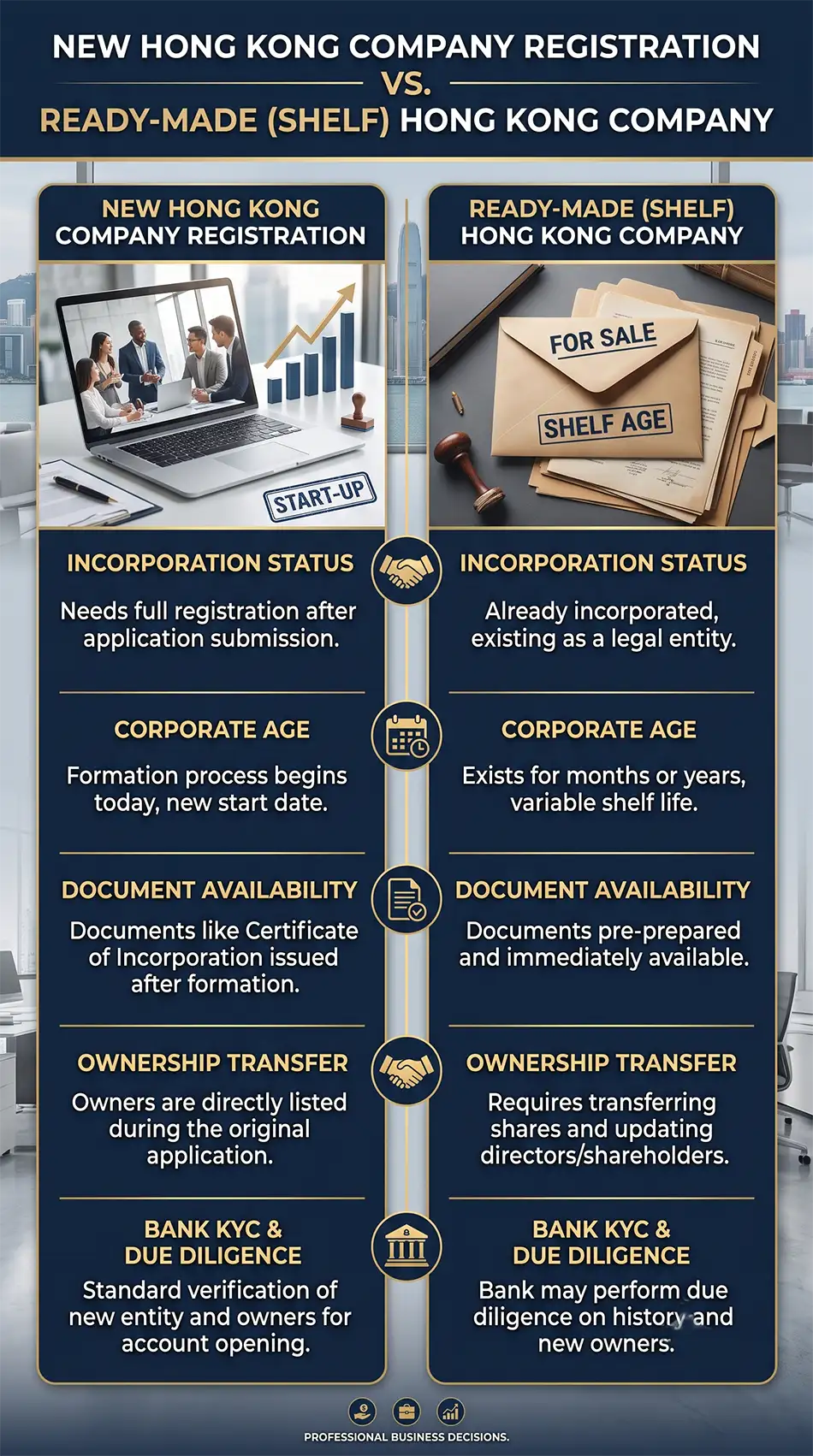
The disadvantages usually arise when buyers focus on corporate age but overlook corporate history. An older entity may carry late filings, tax exposure, bank compliance concerns or obligations that don’t appear in a short sales description.
Typical risks include:
- a higher price than the cost of new incorporation;
- hidden liabilities or incomplete accounting records;
- expired business registration or overdue annual returns;
- bank accounts that require fresh approval or can’t transfer;
- unsuitable business activities, licences or contractual restrictions;
A nominee director doesn’t remove these risks. Hong Kong allows a non-resident to serve as a director, but every private company needs at least one natural-person director. A nominee also holds real statutory duties and can’t conceal the beneficial owner from lawful disclosure, KYC checks or the Significant Controllers Register.
Sale of ready-made companies in HK with Farrion
Farrion Law Firm assists clients from Europe and the rest of the world who want to buy a company in HK without inheriting unverified legal or financial exposure. The firm has many years of experience in the sale of companies in Hong Kong and other international jurisdictions.
Farrion’s acquisition support includes:
- matching the company’s profile with the planned activity;
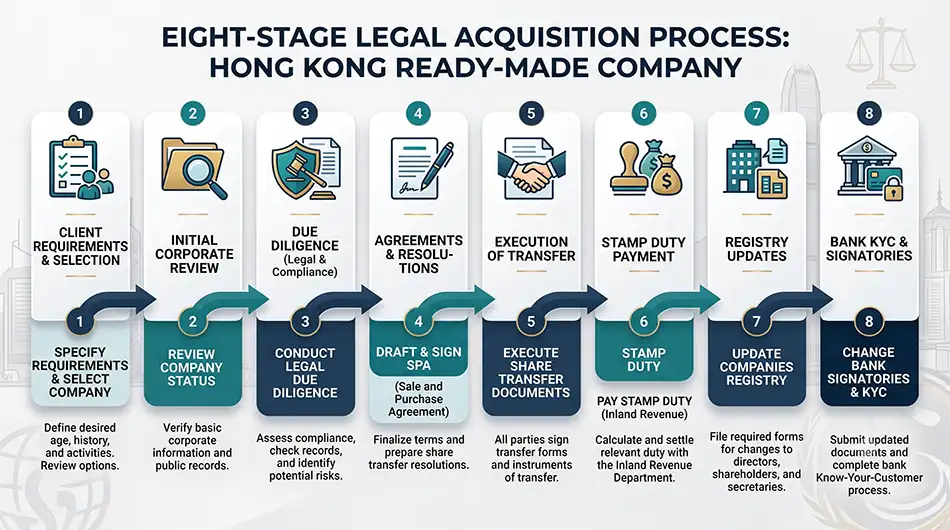
- legal, notarial and financial verification before closing;
- review of filings, accounts, taxes, charges and ownership history;
- transaction documents with seller warranties and liability protection;
- coordinated ownership transfer and post-purchase compliance setup;
When cross-border documents require certification, notarisation, legalisation or an apostille, Farrion coordinates the process across the relevant jurisdictions. Clients receive a structured due diligence report, a closing file and a compliance calendar - not merely a Certificate of Incorporation and an unsupported promise that the company is clean.
Farrion can also assess an active Hong Kong business for sale, but that transaction requires broader commercial and operational review. Each mandate aims at one defined result - a clean, unencumbered and ready-to-operate company that matches the buyer’s actual plans.