
Ready-made companies in Singapore

Companies for Sale Singapore - Why Buy a Ready-Made Company

A ready-made company already exists in the Accounting and Corporate Regulatory Authority register. It has an incorporation date, Unique Entity Number, constitution, issued shares and statutory records. Some entities remain dormant from incorporation. Others have trading history, contracts, licences, employees, assets or active commercial relationships.

When investors buy a company in Singapore through a share acquisition, the legal entity continues without interruption. Its rights stay in place, but so do its liabilities. That distinction matters. Buying shares isn’t the same as purchasing selected business assets.

Main advantages of a ready-made company

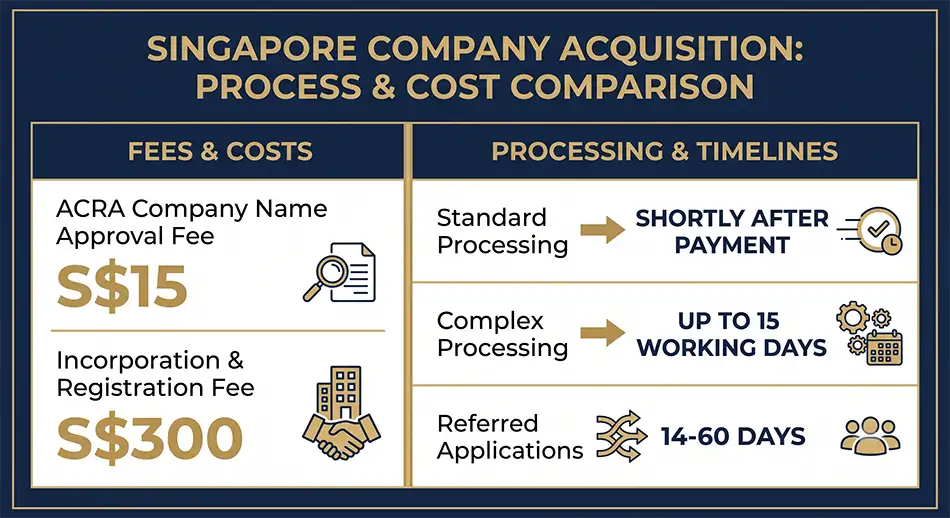
New company registration in Singapore often moves quickly. ACRA approves many standard applications shortly after payment, although complex cases may take up to 15 working days, while referrals to other authorities can extend the process to 14-60 days. A ready-made entity becomes more useful when the buyer needs corporate history, an established structure or operational preparation rather than a basic registration certificate.

The practical advantages depend on the selected company:

  • faster operational launch after ownership and management changes;
  • existing incorporation date and corporate track record;
  • established UEN and completed statutory setup;
  • possible access to valid contracts, permits or commercial registrations;
  • prepared registered office, company secretary and resident director arrangements;
  • easier presentation to suppliers that require an established legal entity;
  • potential continuity of leases, staff agreements and customer relationships;
  • less preliminary corporate administration before market entry;

These benefits don’t arise automatically. Farrion checks every claimed feature and confirms whether it will remain available after the transaction.

Ready-made company versus new incorporation

ACRA charges S$15 for a company name application and S$300 to register a new business entity. A company that requires share capital can start with at least S$1. These low government fees mean that price alone rarely justifies an acquisition.

A buyer should compare both routes against the commercial goal:

  1. Choose a new company when you need a fresh legal entity with no previous activity.
  2. Choose a shelf company when corporate age or immediate structural readiness matters.
  3. Buy a business with operations when you need contracts, employees, equipment or revenue history.
  4. Acquire a licensed company only after confirming change-of-control requirements with the regulator.
  5. Avoid any target whose history, liabilities or beneficial ownership can’t be verified.

The right choice comes from the transaction structure, not the age shown on a company profile.
clean corporate comparison chart for Singapore company acquisition

Legal requirements that continue after the sale

Singapore law requires every local company to have at least one ordinarily resident director. The company must also appoint a secretary within six months of incorporation, and the sole director can’t act as the company secretary. Foreign entrepreneurs must engage a registered Corporate Service Provider when setting up a business structure.

A nominee director can satisfy the residency requirement, but the position isn’t ceremonial. ACRA states that every director remains responsible for statutory records, filings and decisions made in the company’s name. Nominee status doesn’t remove those duties.

Companies must maintain registers of members, registrable controllers, nominee directors and nominee shareholders where applicable. Since June 2025, Singapore’s Corporate Service Providers Act has also strengthened registration and anti-money laundering duties for corporate service firms.

Due diligence before buying a Singapore company

The sale of companies in Singapore transfers more than shares. It can transfer unpaid taxes, contractual defaults, shareholder disputes, regulatory breaches and claims that haven’t yet reached court. That’s why a low purchase price means very little without a verified corporate history.

A proper review covers the following records:

  • ACRA business profile, constitution and incorporation documents;
  • shareholders, directors, secretaries and beneficial owners;
  • issued capital, share classes, allotments and previous transfers;
  • annual returns, financial statements and filing history;
  • IRAS assessments, corporate tax returns and GST status;
  • bank liabilities, registered charges, guarantees and security interests;
  • contracts, leases, employment obligations and related-party transactions;
  • litigation, enforcement notices and regulatory correspondence;
  • licences, permits, intellectual property and change-of-control clauses;
  • source of funds, sanctions screening and seller identification;

Farrion compares seller disclosures with independent corporate, legal and financial evidence. Missing records trigger further questions before the parties sign or transfer funds.

Due diligence before buying a Singapore company

Procedure for purchasing a company

The procedure for purchasing a company changes with the target’s history and assets. A clean shelf company needs fewer contractual protections than an operating business for sale with employees, revenue and regulatory permissions.

The transaction normally follows these stages:

  1. Define the required company age, activity, capital, licences and tax status.
  2. Identify a suitable target and obtain its corporate information.
  3. Complete legal, financial, tax and compliance due diligence.
  4. Agree on the price, warranties, liability allocation and completion conditions.
  5. Sign the share purchase agreement and share transfer instrument.
  6. Pay stamp duty and file the share transfer through Bizfile.
  7. Update directors, secretary, registered office, controllers and corporate records.
  8. Complete bank, accounting, tax and operational handover.

For a private company, the transfer takes effect when ACRA updates its Electronic Register of Members. The parties can’t backdate it. Changes to officers and key company particulars generally require filing within 14 days.

Purchase price, stamp duty and taxes

IRAS charges share transfer duty at 0.2% of the purchase price or the value of the transferred shares, whichever is higher. For an older private company, IRAS generally calculates value using net asset value based on qualifying accounts. Property ownership may require market-value adjustments and further analysis.

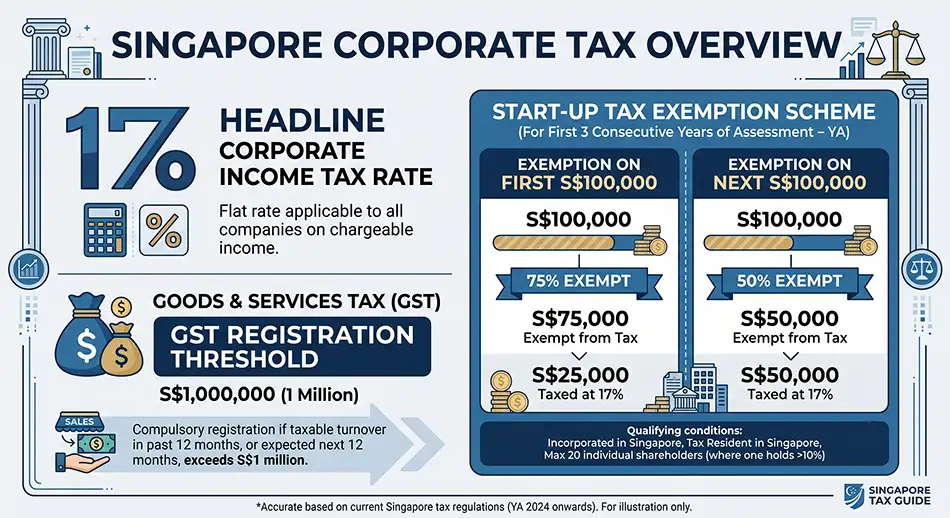
Singapore applies a 17% corporate income tax rate. Qualifying new start-ups can receive a 75% exemption on the first S$100,000 of normal chargeable income and a 50% exemption on the next S$100,000 during their first three consecutive Years of Assessment. An aged company may already have used some or all of that period. Buyers should never assume that purchasing an older entity preserves start-up relief.

GST registration becomes compulsory when taxable turnover exceeds S$1 million under the retrospective test or can reasonably exceed S$1 million during the next 12 months under the prospective test. Farrion checks both current registration and historical exposure.
Singapore corporate tax infographic

Disadvantages and transaction risks

Buying a company isn’t always faster once banks, regulators and counterparties begin their checks. A corporate bank account may require fresh KYC, new signatories and approval of the ownership change. Licences can also contain transfer restrictions.

The main disadvantages include:

  • higher acquisition and advisory costs than new incorporation;
  • inherited liabilities connected with previous activity;
  • expired start-up tax exemption periods;
  • contracts that allow termination after a change of control;
  • licences that require consent, notification or a new application;
  • banking delays during beneficial-owner verification;
  • unresolved accounting records or tax exposure;
  • reputational problems linked to former owners or activities;

Strong warranties help, but they can’t replace verification. A warranty only has value when the seller remains identifiable and financially capable of meeting a later claim.

Farrion support for international buyers

Farrion assists clients from Europe and the rest of the world who want to buy a company, acquire a Singapore Pte Ltd or evaluate a going concern. The firm combines many years of ready-made company transaction experience with legal, notarial and financial review.

Each engagement can include:

  • target selection based on activity, age, capital and commercial purpose;
  • independent corporate and beneficial-owner verification;
  • legal, financial and tax risk mapping;
  • review of licences and change-of-control conditions;
  • transaction documents with tailored warranties and indemnities;
  • coordination of cross-border notarisation where required;
  • share transfer, management change and corporate record updates;
  • post-completion compliance and accounting handover;

Farrion’s sale of ready-made companies in Singapore focuses on clean ownership, documented history and operational readiness. Clients receive a structured transaction file, a clear list of outstanding obligations and a company prepared for lawful business activity.

Request Call

Ask our team to contact you

Get professional advice on buying a company in Singapore.

Or contact us by phone +8651665116 or write to WhatsApp