
Legal Support for Purchasing a Ready-Made Luxembourg Company
A ready-made company already exists as a legal entity. It has articles of association, an incorporation date, registered share capital and an entry in the Luxembourg Trade and Companies Register, known as the RCS. The buyer acquires its shares and changes the ownership, management, registered office or corporate purpose where required.
The phrase «companies for sale» covers two different assets. A shelf company usually has no operating history, employees, contracts or commercial liabilities. An operating business for sale may include revenue, staff, permits, bank relationships, intellectual property and ongoing agreements. Anyone planning to buy a business must separate these categories before discussing price.
Farrion checks the legal substance behind each item rather than relying on the seller’s description:
This review shows whether the company is a clean shelf vehicle or a business carrying earlier obligations. That distinction drives the contract, warranties, price retention and closing mechanics.
The SARL remains a practical structure for privately held companies. Luxembourg requires minimum capital of EUR 12,000, fully subscribed and paid at incorporation. An SA requires at least EUR 30,000, fully subscribed, with at least 25% paid. A transfer of SARL shares to a non-shareholder generally needs approval from shareholders representing at least 75% of the capital.
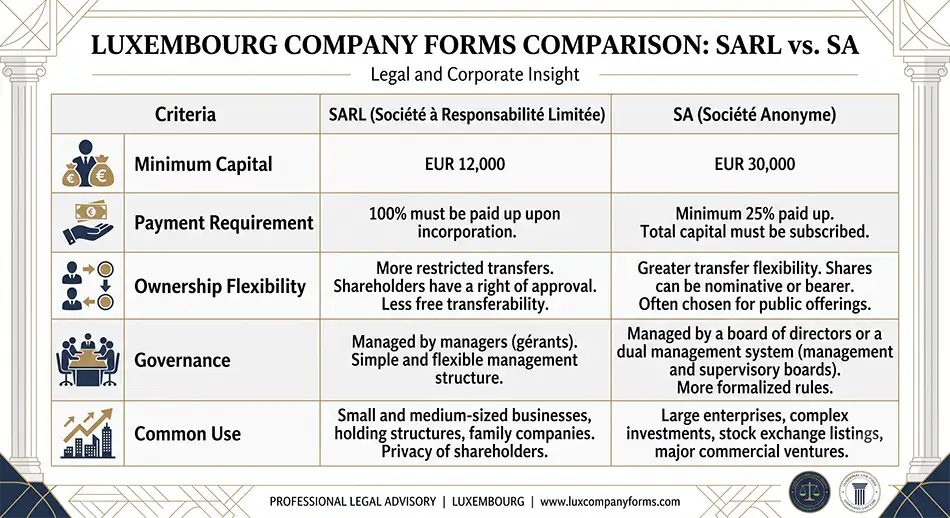
The legal form should follow the commercial plan, not the seller’s inventory. Buyers usually compare these points:
An older registration date can support business presentation, but it doesn’t prove financial strength, banking access or regulatory standing.
The main advantages relate to timing and administrative readiness. The entity already exists, so the transaction focuses on ownership transfer and post-closing changes instead of first incorporation.
These benefits don’t mean instant trading. Banking, VAT registration, sector licences and the business permit still depend on the buyer, the activity and the company’s current status.
The disadvantages sit inside the company’s past. A share purchase transfers the entity itself, so undisclosed debts, late filings, contractual disputes or tax exposure remain attached to it after closing.
A low purchase price can hide expensive clean-up work. Farrion uses legal, notarial and financial due diligence to convert these risks into closing conditions, seller warranties, indemnities or a decision not to proceed.
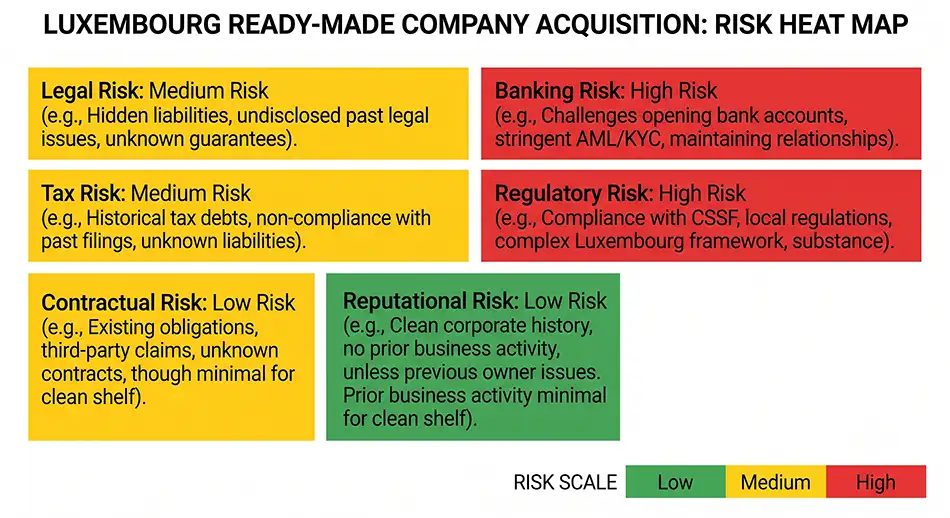
The procedure for purchasing a company changes with its legal form, history and regulated status. A clean shelf SARL needs fewer checks than an operating company with employees, licences and bank debt.
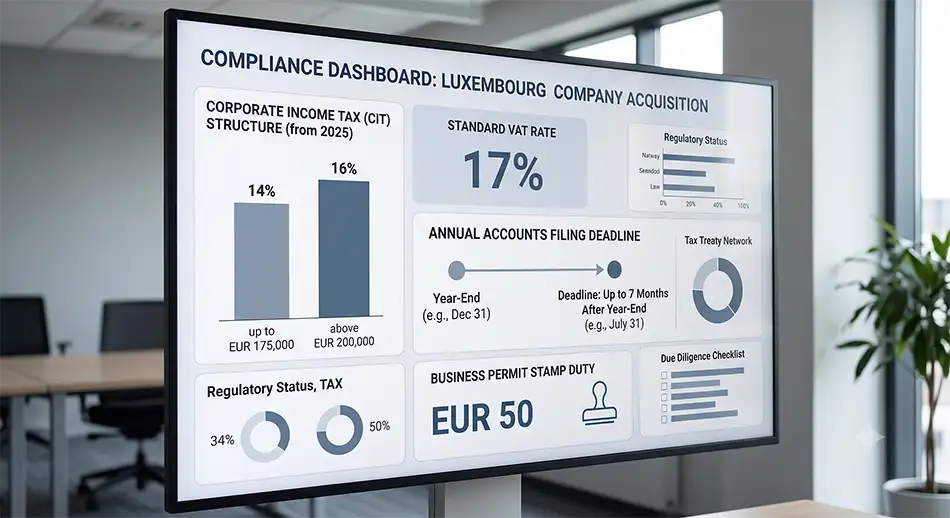
Luxembourg’s RCS records company information, while the RBE holds beneficial ownership details. RBE updates must reach the register within one month after the company knew or should’ve known about the triggering event. Annual accounts normally reach the RCS no later than seven months after the financial year closes.
Buying the shares doesn’t automatically authorise every commercial activity. Many businesses need an establishment permit tied to professional integrity, qualifications where applicable, a suitable physical installation in Luxembourg and effective, permanent management.
Luxembourg doesn’t impose a nationality restriction on SARL managers. Yet the person connected to the business permit must genuinely manage the company and remain physically present at the establishment for day-to-day control. A change in the director linked to the permit can trigger a new permit application. The stamp duty for issuing a business permit is EUR 50.
A nominee director can’t serve as a name on paper while the real decision-maker stays hidden. Any nominee arrangement needs written authority limits, conflict rules, access to records, AML checks and accurate beneficial ownership disclosure. Farrion assesses whether the governance matches Luxembourg substance requirements and the client’s operating model.
From tax year 2025, corporate income tax equals 14% when taxable income doesn’t exceed EUR 175,000 and 16% when it exceeds EUR 200,000. A statutory formula applies between those amounts. Municipal business tax and the solidarity surcharge may also apply. The standard VAT rate remains 17%.
Farrion’s financial review checks whether the company has filed accounts, paid assessed taxes, reconciled shareholder balances and recorded all liabilities. For an active business, the review also tests revenue quality, payroll exposure, VAT treatment and related-party transactions.
Farrion Law Firm supports clients from Europe and the rest of the world who want to buy a company in Luxembourg without inheriting avoidable risk. The firm draws on many years of work with ready-made company transactions and combines transaction management with legal, notarial and financial verification.
This service covers the sale of companies in Luxembourg, the sale of ready-made companies in Luxembourg and selected operating businesses. A client searching for a business for sale receives a transaction structure suited to an asset with history. A client seeking a shelf vehicle receives evidence that the entity stayed clean, unencumbered and ready for lawful operation.
Farrion doesn’t treat every offer as suitable. The team verifies the company first, explains the remaining conditions and only then moves to signing. That approach gives buyers a controlled route to buy a company, change its corporate profile and start operating with records that match the real business.
Get professional advice on buying a company in Luxembourg.
Or contact us by phone +8651665116 or write to WhatsApp
Design by Gramatorik – All rights reserved.