Ready-made companies in Spain

Companies for sale Spain - legal support for buying a ready-made Swiss company.

A ready-made company in Spain is an existing legal entity whose shares or participations pass from the seller to the buyer. Most offers use the Sociedad Limitada, or SL. SL companies represented 98.7 percent of all company formations registered in Spain in 2025.

The term «ready-made» can describe very different assets.

  • a shelf company incorporated but never used for trading;
  • an older dormant company with filed accounts;
  • an operating business with staff, customers and contracts;
  • a company that owns licences, property or intellectual property;
  • a distressed entity with debts, disputes or incomplete filings;

The buyer acquires the same legal person, not a blank entity. Its corporate history, tax position, contracts and potential liabilities remain attached after the ownership change.

Demand for Spanish companies

Spain recorded 128,871 company formations in 2025, 7.9 percent more than in 2024. Registrars then reported 39,259 new companies during the first quarter of 2026, an annual increase of 28.3 percent. The twelve months ending in March 2026 produced 137,529 formations.

These figures show an active corporate market, but they don’t make every business for sale safe.
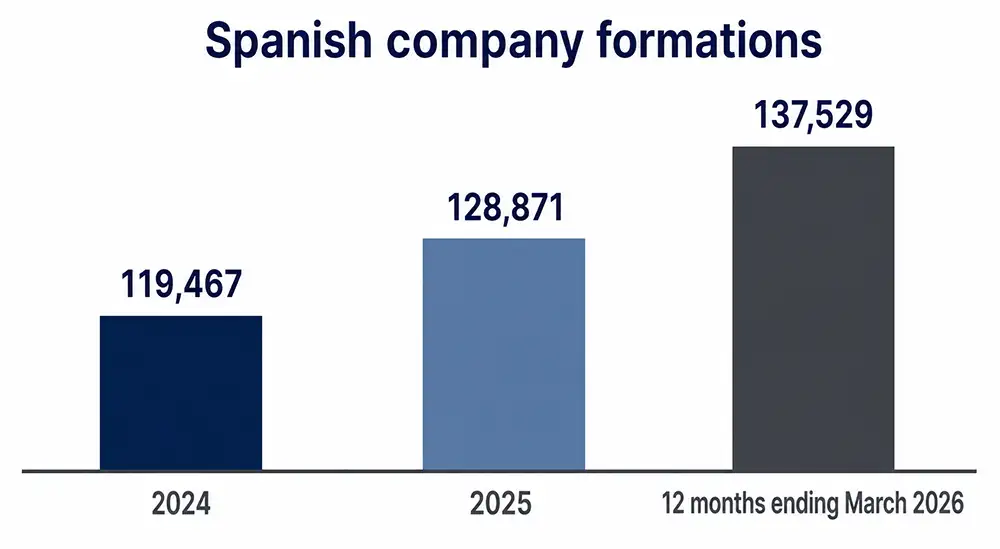
professional bar chart showing 119,467 Spanish company formations in 2024

Advantages of buying a ready-made company

Investors often choose to buy a company in Spain before a contract, tender, property transaction or market launch. Buying can remove incorporation steps, though the real time saving depends on due diligence and document readiness.

The main advantages include:

  • access to an entity already entered in the Commercial Registry;
  • an established corporate name, registered office and tax identity;
  • possible corporate age for supplier checks or tenders;
  • existing contracts, staff, licences or assets when included in the deal;
  • a shorter route to trading when the records are clean;
  • continuity for investors who buy a business rather than build one from zero;

Spain permits an SL to start with share capital of €1. Until capital and legal reserves reach €3,000, the company must allocate at least 20 percent of profit to the legal reserve. Extra shareholder exposure can also arise on liquidation if company assets don’t cover its obligations. A ready-made SL with €3,000 or more may offer a simpler capital position, but the buyer must verify the records.

Disadvantages and hidden risks

Speed can hide expensive problems. A short registry extract can’t replace legal and financial review.

Common disadvantages include:

  1. Hidden tax liabilities may relate to earlier VAT, payroll or corporate tax periods.
  2. Unpaid suppliers, loans, guarantees or related-party balances may reduce the company’s value.
  3. Employment claims can remain because the employer is still the same legal entity.
  4. Old powers of attorney may let former representatives act until the buyer revokes them.
  5. Licences may require notice, consent or fresh approval after management changes.
  6. Incomplete accounts or beneficial ownership filings can delay closing and banking.
  7. Corporate age may increase the price without giving the buyer a practical benefit.

Tax treatment needs separate analysis. For 2026, Spain lists a 25 percent general corporate income tax rate, a 23 percent rate for qualifying reduced-size entities, and tiered rates of 19 percent and 21 percent for micro-companies with turnover below €1 million. Newly created entities can qualify for 15 percent, but buying an existing company doesn’t create a new entity or guarantee that rate.

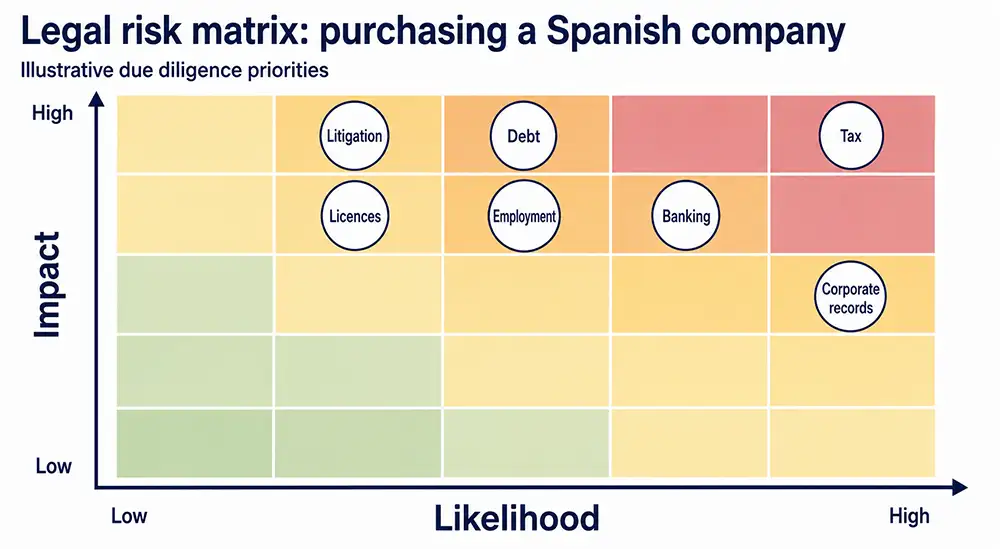
legal risk matrix for purchasing a Spanish company

Legal and financial due diligence

Farrion starts with documents, not promises. The firm conducts legal, notarial and financial due diligence to establish what the company owns, owes and may still face.

A proper review should cover:

  1. Confirm the registration status, capital, office, corporate purpose and filing history.
  2. Check the articles for transfer restrictions, approvals and pre-emption rights.
  3. Verify shareholders, directors, beneficial owners, corporate books and powers of attorney.
  4. Review accounts, bank statements, tax returns and social security records.
  5. Search for litigation, enforcement, insolvency indicators, pledges and guarantees.
  6. Analyse employees, leases, licences, insurance, intellectual property and key contracts.
  7. Match seller statements with independent records and supporting evidence.
  8. Turn unresolved issues into corrections, price adjustments, retentions or warranties.

The review produces a clear choice: proceed, renegotiate or reject the target. It also shows whether the offer concerns a clean shelf company or an operating target requiring deeper analysis.
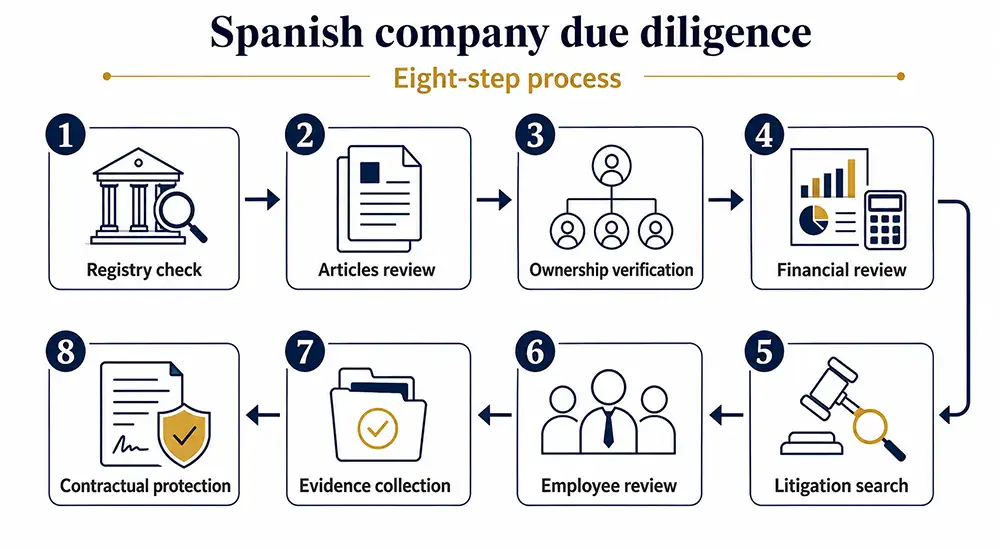

eight-step Spanish company due diligence process with icons for registry

Procedure for purchasing a company

The procedure for purchasing a company usually involves transferring participations in an SL. Spanish law requires the transfer to appear in a public document. The articles may impose restrictions, while statutory rules can require notice to directors and shareholder approval.

A controlled purchase follows these stages:

  1. Define the buyer, intended activity, budget and required company age.
  2. Select suitable companies for sale and obtain the document package.
  3. Complete due diligence before paying the purchase price.
  4. Agree warranties, indemnities, payment terms and closing conditions.
  5. Obtain approvals and waivers required by the articles or law.
  6. Sign the public transfer document and shareholder resolutions.
  7. Appoint directors, revoke old powers and update the shareholders’ register.
  8. Update tax, beneficial ownership, banking and licensing records.
  9. Transfer the accounting file and create a compliance calendar.

The sale of companies in Spain doesn’t end at signing. The buyer must also control records, digital certificates, banking and tax correspondence.

Foreign buyers and ownership disclosure

Farrion assists clients from Europe and the rest of the world. A non-resident individual will generally need a Spanish NIE for economic dealings. A foreign corporate buyer may need a Spanish NIF and documents proving registration, representation and ownership. Foreign documents commonly require legalisation or an apostille and a sworn Spanish translation.

Spanish anti-money-laundering law generally treats a natural person who directly or indirectly owns or controls more than 25 percent of capital or voting rights as a beneficial owner. When beneficial ownership changes, administrators must submit an updated declaration to the relevant Commercial Registry within ten days after learning of the change.

Nominee director service

A nominee director may support a short transition while the buyer completes identification. The role can’t conceal the beneficial owner or function as an empty signature.

Farrion structures the service around clear controls:

  • documented limits on decisions and signing rights;
  • instructions approved by the beneficial owner;
  • separate control over banking and payments;
  • scheduled reporting and access to records;
  • replacement when permanent management is ready;

Spanish law requires directors to act diligently and can hold legal and de facto directors liable for damage caused by unlawful acts, breaches of the articles or failures in their duties where fault or intent exists. A nominee director therefore needs full information, supervision and a written mandate.

Farrion assistance with ready-made companies

Farrion manages the sale of ready-made companies in Spain as a legal transaction, not a handover of corporate papers. The team coordinates the buyer, seller, notary, accountant and other professionals involved.

Clients receive:

  • company selection based on activity, age, capital and operating plans;
  • legal, notarial and financial verification;
  • a written risk report supported by documents;
  • correction of corporate defects before purchase;
  • tailored agreements, warranties and indemnities;
  • remote closing through a prepared power of attorney;
  • director replacement and beneficial ownership updates;
  • accounting, tax and corporate support after completion;

The service aims to deliver a clean, unencumbered and ready-to-operate company whose records match the agreed transaction. When risks remain, Farrion identifies them before payment and places specific protection in the closing documents.

Choosing the right company for sale

A credible offer should state the incorporation date, capital, trading history, filing status, bank position, assets, liabilities and included services. The buyer should know whether the price covers notarial work, director changes, office services and post-closing support.

Farrion helps investors buy a company with a verified legal position rather than rely on labels such as «clean», «aged» or «ready to trade». That difference turns a quick transfer into a controlled entry into the Spanish market.

Request Call

Ask our team to contact you

Get professional advice on buying a company in Spain.

Or contact us by phone +8651665116 or write to WhatsApp